When the grid goes down, your spring keeps flowing.
Develop your spring the right way—and build a water system that can keep your family supplied when everything else gets shaky.
You may think you have a great spring…
…until August hits and the flow collapses.
…until the first heavy rain turns the water cloudy.
…until winter freezes the line.
…until the cistern gets contaminated.
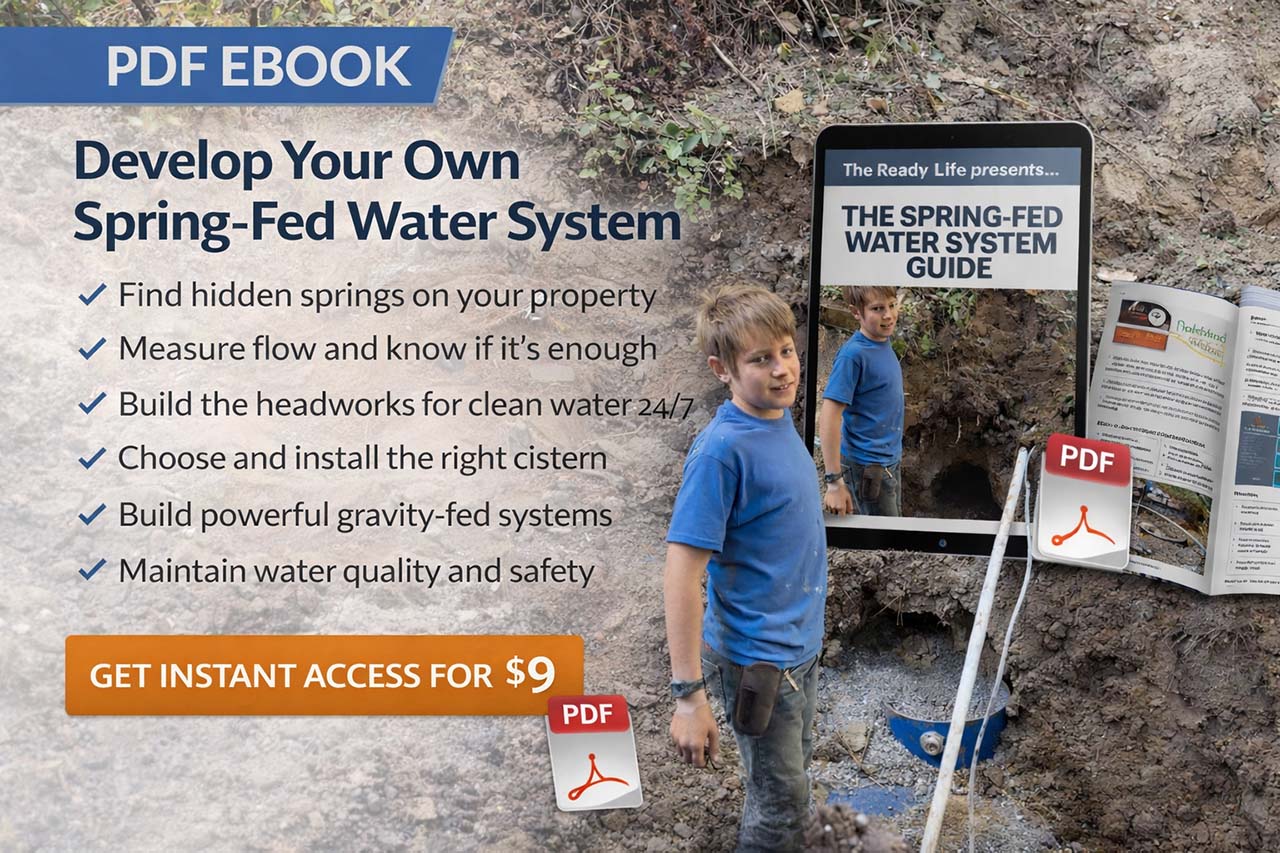
This guide walks you step-by-step through the spring development method that actually works!
Inside this 37-page guide, you’ll learn how to avoid:
-
Building your entire water plan around a “wet-season spring” that fades when it matters most
-
Getting weak pressure because the cistern is too low (or in the wrong place)
-
Losing water every night because you didn’t add storage
-
Contaminating your cistern through a bad manhole seal, overflow routing, or poor drainage
-
Freezing failures that take down the whole system
-
Assuming water is “safe” because it looks clear (you can’t see bacteria)
When a storm hits—or when the grid goes dark—this is the difference between being prepared and being dependent.
You’ll Get:
🔹 How to Find Springs (Even When Nothing Is Obvious)
Simple, practical ways to read the land—vegetation clues, road cuts, seep zones—so you’re not digging blind.
🔹 Flow Rate Testing (So You Know What You Actually Have)
A fast, repeatable way to measure real output—then convert it into daily gallons so you can plan with confidence.
🔹 Spring Development Steps (Headworks That Stay Clean)
How to capture the spring, protect it from surface intrusion, and route it into a system you can trust—not a muddy science experiment.
🔹 The “Ultimate Setup” Gravity System (No Pump, No Electricity)
What it takes to run a home on gravity pressure—no moving parts, no generator, no fragile dependencies.
🔹 The Gravity Pressure Formula
You’ll see what that means in real life, including how much drop you need for normal household pressure.
🔹 Three Proven System Scenarios (So You Stop Guessing)
- Spring high above the home (ideal: gravity-fed)
- Spring above the home but not high enough (gravity + booster pump)
- Spring at or below the home (cistern + transfer pump)
- And the key rule that makes or breaks every design: your cistern must be lower than the spring (so it fills) and higher than the house (so it pressurizes).
🔹 Pumping Options That Actually Make Sense Off-Grid
- Booster pump when you have some gravity but not enough pressure
- Submersible transfer pump when the spring is at/below home level (with pressure tank basics)
- Ram pump overview—when it works, when it doesn’t, and why it’s usually better for creeks than springs
🔹 Cistern Sizing + Installation Details That Prevent Regret
The little details most people skip… and then pay for later: overflow routing, seal protection, french drain ideas, frost considerations, and ways to avoid contamination during rain events.
🔹 Freeze Protection / Winterizing Checklist
Because one shallow line can take down the entire system in January.
🔹 Protecting Water Quality (Testing Plan + What to Test For)
A “test before you drink” plan, including what to test for, why, and where
🔹 Water Purification (What to do if it’s not pure)
Straighforward recommendations for purifying your spring water if it turns out to be less than ideal.
🔹 Money-Saving Tips (Without Cutting Corners)
Where you can save on pipe, tanks, and testing—without turning your water system into a liability.